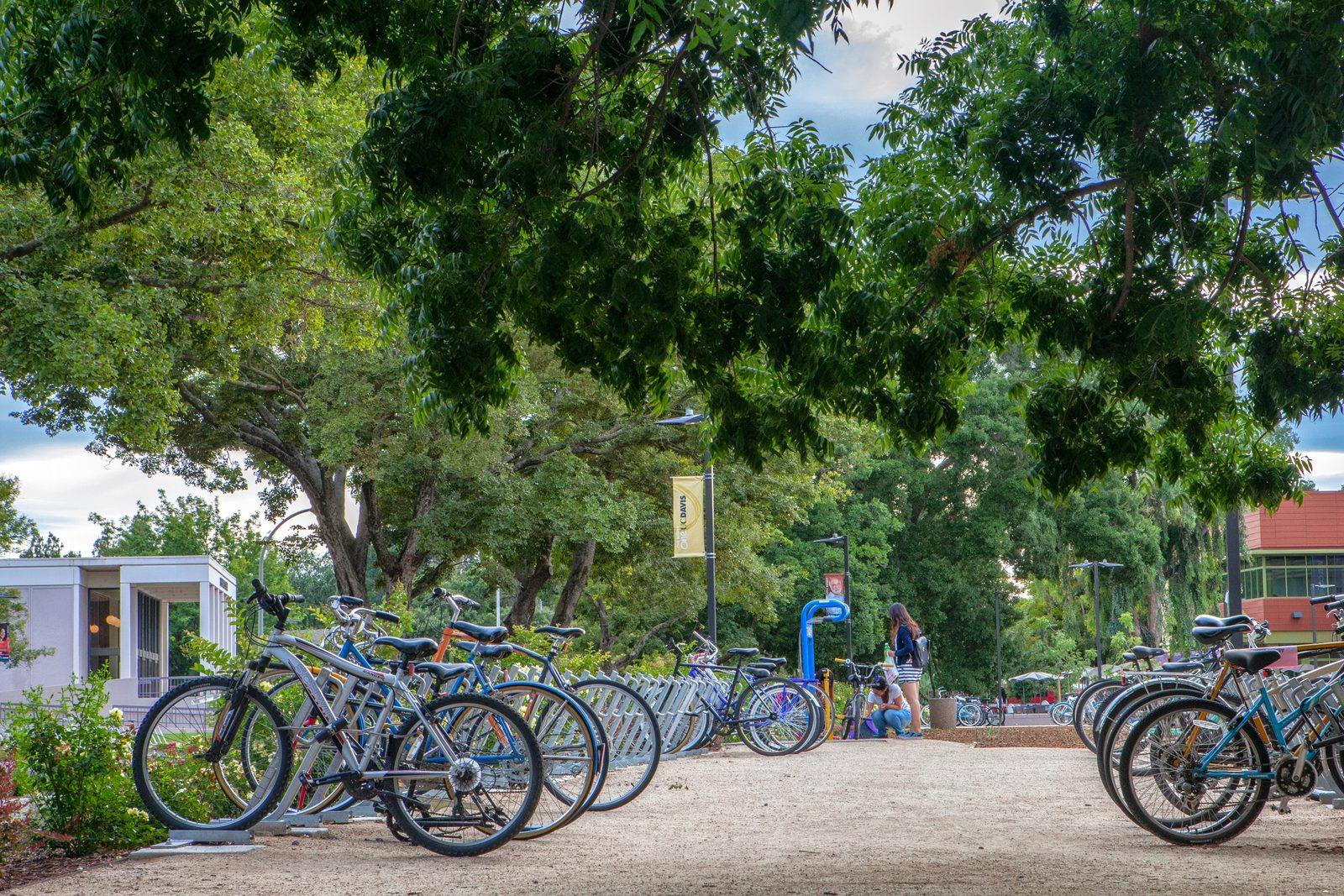
If Wine Country's AI industry has a research anchor, it is forty miles northeast of Napa, in Davis. The University of California, Davis has assembled the region's deepest bench of agricultural AI research, and the pipeline from its labs to commercial vineyards is now short enough to trace.
The institutional foundation is the AI Institute for Next Generation Food Systems, known as AIFS. Funded by a $20 million award from the USDA's National Institute of Food and Agriculture in 2020 and led by UC Davis, with partners including UC Berkeley, Cornell, the University of Illinois Urbana-Champaign, UC Agriculture and Natural Resources, and the USDA's Agricultural Research Service, AIFS applies AI and bioinformatics across the food system, including sensing platforms relevant to specialty crops. It is the largest single federal bet on AI for food and agriculture in the region's orbit.
The lab-to-startup path runs through Mason Earles, a UC Davis professor who leads the Plant AI and Biophysics Lab. The lab works on AI for crop health assessment, yield prediction, and virus detection. Earles is also co-founder and CTO of Scout, the Davis-area startup putting AI vision on tractor-mounted cameras in commercial vineyards. The dual role, professor and founder, is the mechanism by which academic research becomes a product growers can buy, and it makes Earles one of the most important figures in the region's AI ecosystem.
The newest industry collaboration is the October 2026 joint effort between Moet Hennessy, Analog Devices, and UC Davis on AI chemical-signature sensing for wine quality, with UC Davis participation led by Ben Montpetit, professor and chair of the Department of Viticulture and Enology. The project trains machine learning models to recognize the chemical signatures of quality risks, starting with Fresh Mushroom Aroma. It is a notable vote of confidence from a global luxury group in university-led AI research, and it puts Davis at the center of one of the industry's most ambitious sensing projects.
The student pipeline is visible too. In May 2026, a UC Davis team called Aggie Aerial-Ground Robotics won the Western Growers Award for Excellence in Specialty Crops at the Farm Robotics Challenge for Project BloomSense, which combined drone and ground-robot imagery with AI to estimate bloom density and yield. The team's advisor was Ali Moghimi, an assistant professor in Biological and Agricultural Engineering. Student competitions are leading indicators: today's BloomSense team members are tomorrow's startup founders.
The lineage extends further back. Tule Technologies, a UC Davis spinout founded on licensed evapotranspiration sensing research, was acquired by CropX in 2023, an early example of Davis sensor science finding a commercial home.
Two boundaries keep this coverage honest. First, UC Davis's agricultural robotics work, including professor Stavros Vougioukas's programs and the RAPID precision-irrigation project that ran trials in Napa Valley vineyards, belongs to our sibling publication NAPA ROBOTICS; this publication covers the AI and sensing science. Second, the wider Bay Area picture is thinner than it looks: UC Berkeley's agricultural work, including Ken Goldberg's AlphaGarden automated polyculture testbed, operates at garden scale rather than in vineyards, and Stanford has no documented vineyard AI deployment. UC Davis stands largely alone as the region's vineyard-AI research institution, which is both its strength and a concentration risk for the ecosystem.
The question for the next five years is whether the research engine can keep producing companies, not just papers. AIFS funding, the Scout spinout, and the Moet Hennessy collaboration suggest the pipeline is working. The measure will be how many Davis-trained founders build in Wine Country rather than leaving for row crops or departing agriculture entirely.