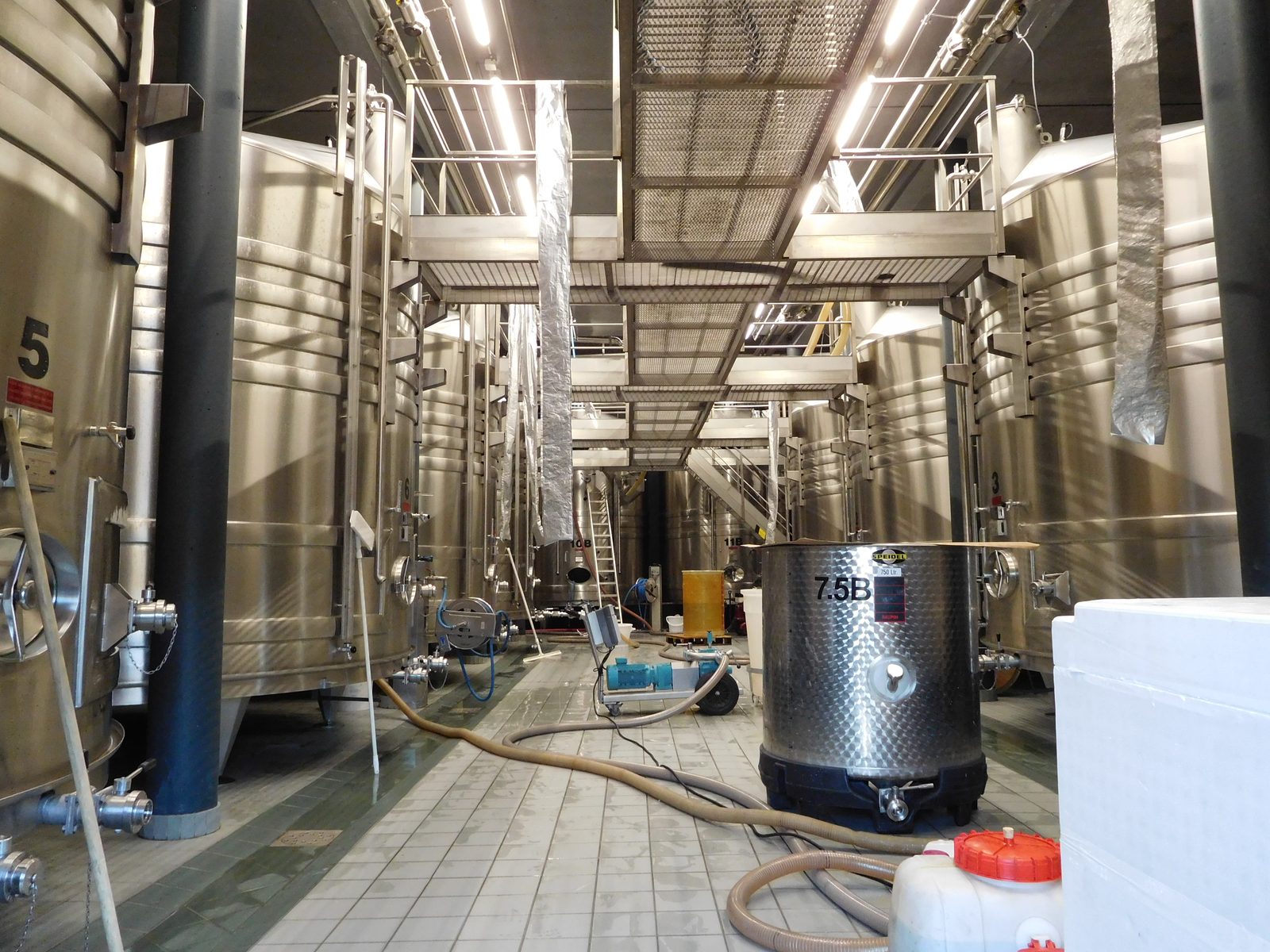
The vineyard gets the cameras and the headlines, but some of the most advanced AI in the wine business lives inside stainless steel tanks. Fermentation, the biological heart of winemaking, is becoming a data problem, and Napa Valley holds one of the world's most ambitious examples.
Palmaz Vineyards built its system in-house rather than buying it. The estate's Fermentation Intelligence Logic Control System, FILCS, adapts submarine sonar technology to the cellar: probes in each tank measure liquid vibrations ten times per second, a technique called sonodensitometry, converting density readings into sugar and alcohol levels and fermentation rates in real time, paired with precise per-zone temperature control. The same estate built VIGOR, Vineyard Infrared Growth Optical Recognition, which applies AI to multispectral aerial imagery combined with soil probes for irrigation and vine-health decisions. The systems process billions of data points through proprietary AI. The account is corroborated by both Digital Trends and a Harvard Business School digital-innovation case write-up. FILCS is not a product for sale; it is a competitive advantage kept inside one Napa estate, which makes it a deployment story rather than a vendor story, and also means no other winery can buy what Palmaz built.
The commercial market is developing in parallel. WINEGRID, a Portuguese company, sells wireless smart sensors that sit in tanks and barrels during fermentation and aging, measuring density, temperature, and liquid level, with data flowing to a cloud platform where AI software performs predictive analysis of fermentation kinetics: anticipating start, stuck, and completion events to reduce manual sampling. The company was majority-acquired by Enartis, the Italian wine-supply multinational, as the anchor of its "Smart Enology" push, a sign that fermentation analytics is consolidating into the industry's supply chain rather than remaining a startup niche. What WINEGRID cannot document, in the sources reviewed, is a single named Napa, Sonoma, or California customer. Its predictive claims are vendor-stated.
Winely, an Australia and New Zealand company, offers in-tank IoT sensors with a cloud platform applying machine learning to fermentation monitoring and prediction, claiming its models can be updated over the cloud mid-vintage without hardware changes. The launch coverage dates to 2022, no named winery customers were found in published sources, and the company's current operating status could not be confirmed. Its "breakthrough" language comes from vendor press releases. It belongs in this account as evidence of global activity, not as a Wine Country deployment.
The unglamorous foundation underneath all of it may matter most. InnoVint, headquartered in Napa, sells a cloud-based winery operating system: vineyard tracking, grape intake, bulk movements, lab analysis, work orders, costing, compliance. No AI features were found in its published materials. But its customer list is pure Wine Country: The Duckhorn Portfolio selected InnoVint as its winery operating system after a formal request-for-proposal process in March 2026, and Davis Estates and O'Shaughnessy are documented users. InnoVint is the digital backbone that AI tools will eventually plug into; the operating system comes before the intelligence.
The research layer adds one more Napa connection. UC Davis enology researcher Anita Oberholster ran optical-sorter trials with industry partners including Plata Wine Partners and Silverado Winegrowers of Napa, applying machine vision to berry sorting for wine quality. Classical machine vision rather than modern machine learning, but the same principle: instruments making quality decisions at speeds humans cannot match.
Now the honest gap, stated plainly because this publication does not fill gaps with inference: no AI cellar-analytics vendor with a documented, named Napa or Sonoma customer was found in this research pass. The most advanced fermentation AI in Napa is proprietary to one estate. The commercial products with the strongest AI claims sell elsewhere or decline to name customers. That gap is itself the story: the cellar is where wine AI is thinnest, and where the next verifiable deployment will be news.